Workplace Wellbeing Consultancy for HR & People Leaders
Workplace Wellbeing & Culture Audit
A workplace-reflection framework exploring whether your teams are driven by sustainable inspiration (Hope) or chronic stress and depletion (Hunger).
For HR and People teams seeking a clearer view of staff wellbeing and workplace culture: a five-minute questionnaire every quarter that explores employees' reported experience in a clear, comparable view — then matches that view against the operational, P&L, and staff-retention data already in your business.
The audit and consultancy are available online to organisations worldwide.
Download service overview (PDF) — agree confidentiality arrangements before useAt a glance
A workplace wellbeing and culture audit examines employees’ experience alongside existing business data to identify questions and priorities for action. Frven’s Hope/Hunger approach is a proprietary reflection framework, not a clinical diagnosis or a substitute for a formal stress risk assessment.
- Who it is for
- HR, People and organisational leaders who need a clearer picture of workload, support, culture and retention.
- Delivery
- Audit and consultancy conversations are available online to organisations worldwide. Agree the teams, locations and review period in the brief.
- Process
- Define the decision and baseline, agree how responses will be collected and interpreted, compare patterns with operational data, then identify priorities for action.
- Reporting brief
- Agree the report and review meeting in advance: themes, relevant comparisons, limitations and recommendations, with owners and a review date for proposed actions.
- Privacy before collection
- Agree what is anonymous, confidential or named, who can access each type of result, retention arrangements and whether follow-up is voluntary. Do not promise anonymity where individuals can be identified.
- How fees are agreed
- The audit is priced by scoped quotation, not a published per-person tariff. Bring your objectives, teams, locations, review period and available data so the collection, analysis, reporting and review work can be agreed before commissioning.
- Audit or ongoing consultancy?
- An audit defines findings and priorities for an agreed brief. Culture Transformation consultancy is a separate ongoing offer, starting from £2,500 per quarter with its own agreed scope; that is not the audit's starting price.
- Limits
- A score does not diagnose illness or prove a cause of absence, turnover or profitability; interpret findings in context.
What evidence should an audit use?
The HSE Management Standards address demands, control, support, relationships, role and change. The WHO guidelines on mental health at work provide an independent reference for organisational interventions. These references inform the discussion; they do not constitute endorsement or validation of Hope/Hunger. Agree a documented disclosure and support process before collecting sensitive responses. Use a redacted example for public demonstrations, not identifiable respondent results.
A reason to look closer
Why bother reading this? Because your best competitors are already moving beyond basic compliance.
If your strategy is simply keeping your head down, putting out daily fires, and meeting the bare legal threshold for people management, you won't need this framework.
But if you intend to set the benchmark across your sector, you need deeper visibility into what is actually driving your people:
- Pre-empt burnout risks by identifying who is red-lining on pure, unsustainable hunger before you lose them.
- Amplify natural catalysts by discovering who holds the hope and perspective to rally, inspire, and elevate their peers.
- Prove institutional maturity to regulators, audit bodies, and clients by demonstrating an organisation operating five years ahead of standard practice.
5 min
per staff questionnaire
4× / year
quarterly pulse
1 index
Hope relative to Hunger
2 lenses
inner assets and burdens
The missing quarterly view
You already screen your people's physical health.
Who is listening to their experience of work?
Annual health screening is familiar because physical indicators matter. But inner states change much faster than an annual cycle, and the human signals behind engagement, performance, and retention often remain hidden until an exit interview.
Hope vs Hunger adds a regular, practical pulse to the picture. It does not ask managers to become therapists or bury them in another dashboard. It helps them know which conversations matter now.
The Hope / Hunger Index
Two forces in tension. One useful number.
Each staff member completes a quick questionnaire. The ratio of the two lenses produces a comparable Hope/Hunger Index and a one-glance map of the organisation's emotional health.
Hope
Inner assetsThe resources people can draw on when work becomes demanding.
Hunger
Current burdensThe pressures that can quietly consume energy and attention.
Hope vs Hunger dashboards
See the pattern, not just the average.
These indicative dashboard views show how the Hope vs Hunger map can change over time — making it easier to see who is thriving, who may be quietly struggling, and where the middle is drifting.
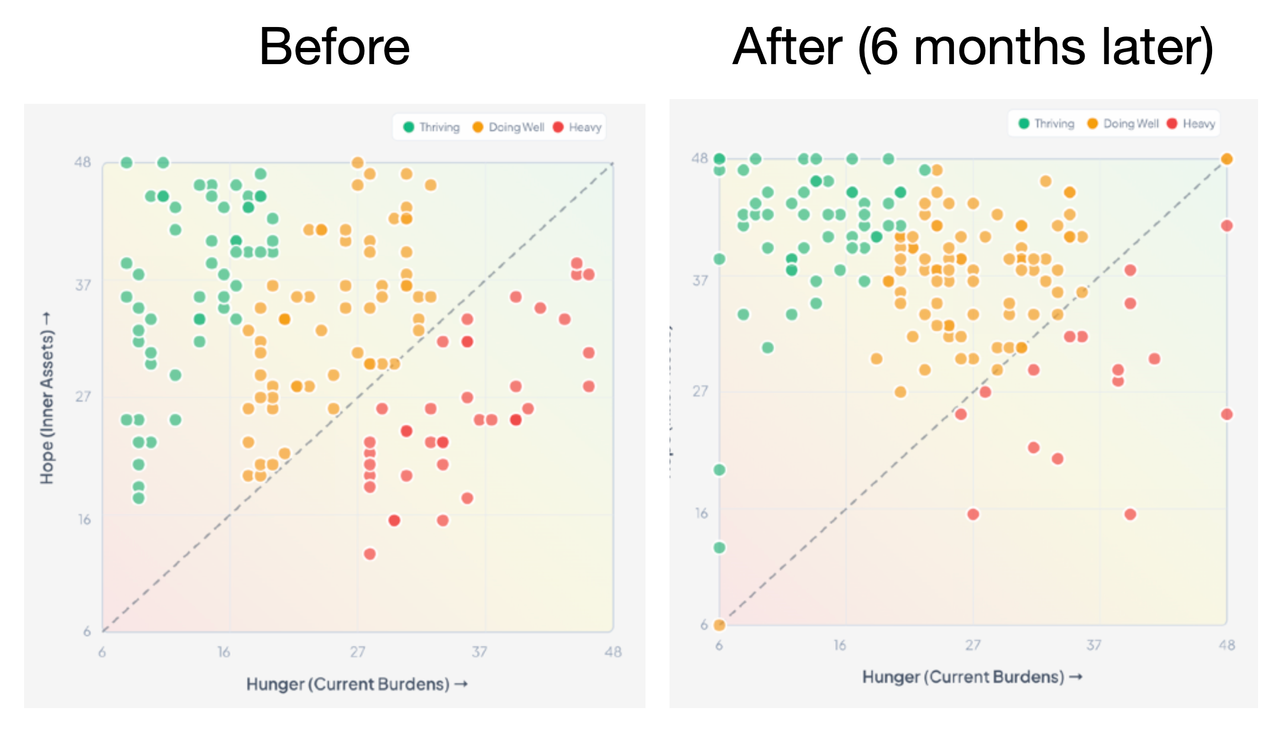
Indicative dashboards for illustrative and explanatory purposes only.
From measurement to conversation
The outliers are where the useful work starts.
Most engagement surveys drown managers in averages. Hope vs Hunger focuses attention at both extremes, where one well-led conversation can have disproportionate value.
The thriving few
Recognise and multiply what works.
Learn how resilient people are coping, acknowledge inner strength rather than output alone, and — with permission — share the habits or stories that can lift the wider team.
The quietly struggling
Offer support before the exit interview.
Where current burdens outweigh hope, managers receive a practical prompt: meet a tangible need where possible, or offer a genuinely attentive listening space.
Everyone else: watched, not bothered.
The broad middle is tracked quarter-on-quarter. There is no forced intervention and no survey fatigue — just early notice if a person or team begins drifting toward an extreme.
Consultancy layer
Put the human data next to the business data.
Wellbeing becomes more actionable when it is not left in a separate HR report. We help you matrix quarterly Hope and Hunger movement against the measures your leaders already use to run the organisation.
Wellbeing
Hope and Hunger signals tracked quarter-on-quarter
Operations
The measures that show how work is flowing and where pressure is accumulating
P&L
The financial indicators that matter to your sector and operating model
Retention
Staff movement, tenure, vacancies, and the cost of losing capable people
Spot
Where energy and performance are diverging
Steer
Which conversations or interventions deserve attention
Sustain
A path toward high productivity and high profitability
A more useful conversation about wellbeing
Hope vs Hunger is an organisational wellbeing tool, not a clinical diagnosis. We agree the right confidentiality, safeguarding, and data-governance boundaries before anything is introduced, so the information can support people without turning them into data points.
Available to organisations in London and Singapore, and online worldwide.
Frequently asked questions